
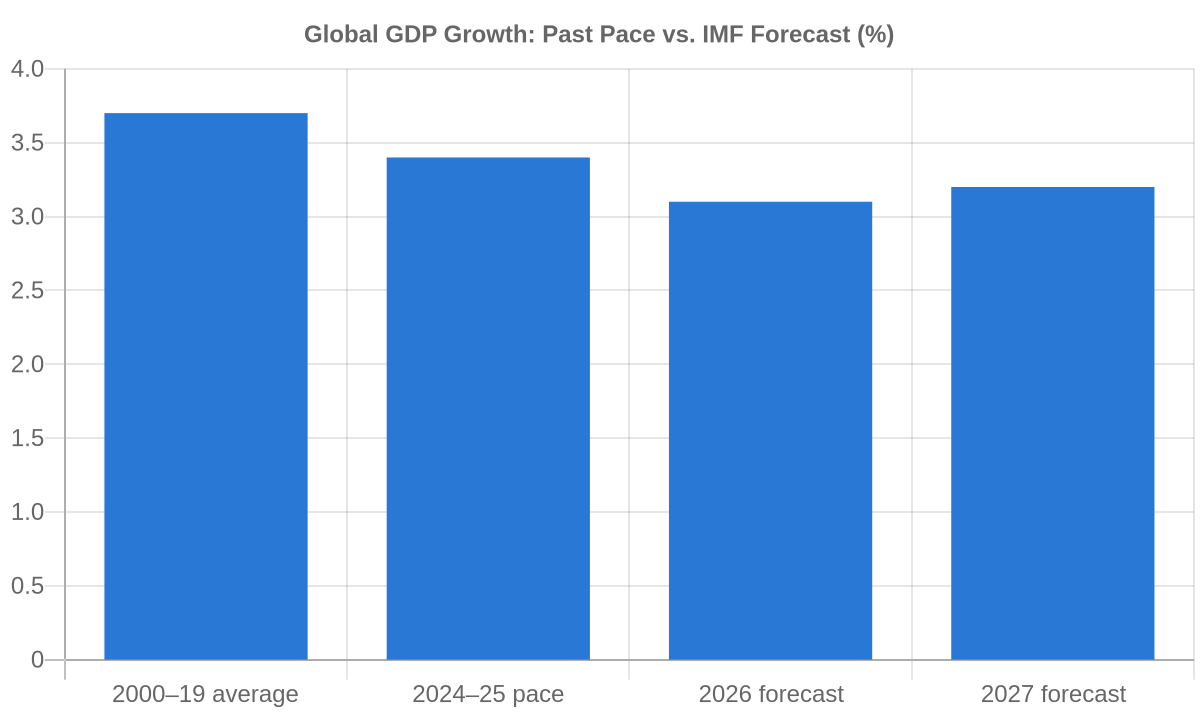
Here is a number worth a second look. The IMF's April 2026 World Economic Outlook estimates that AI-related technology investment added 0.5 percentage point to U.S. economic growth in 2025. That is a sizable contribution from a single category of spending. Yet the same report projects global growth of just 3.1% in 2026 (below the 3.4% pace of 2024 and 2025, and the 3.7% average for 2000 through 2019). So is AI holding the economy up, or inflating something fragile? The evidence supports both readings.
Global real GDP growth in %; source: IMF World Economic Outlook, April 2026.
## What has AI delivered so far, and what is still a promise?
The spending is real, while the payoff is mostly projected. The 0.5 percentage point came from building things (servers, chips, data centers). The productivity gains that would justify all that building remain an estimate. The IMF figures that faster AI adoption could lift global growth by 0.1 to 0.8 percentage point over the medium term, with perhaps 0.3 percentage point arriving sooner. A range that wide is an honest way of saying nobody knows yet.
## How big is the bill?
InfoWorld reported in October 2026 that Microsoft, Alphabet, Amazon, Meta and Oracle had committed between $660 billion and $690 billion of 2026 capital spending, against roughly $388 billion spent by four of those companies in 2025. The Boston Globe, counting somewhat differently, put 2026 plans above $800 billion, nearly double the prior year. Because the groupings and definitions differ, treat both totals as approximate. Looking further out, the IMF identifies about $3.4 trillion of AI-related capital spending through 2029, and Columbia Business School economist Stijn Van Nieuwerburgh estimates that AI infrastructure could average 3.2% of GDP annually from 2025 through 2032.
## Who pays for it, and what must it earn?
Spending is one thing; return is another. Van Nieuwerburgh estimates that data centers coming online through 2032 would need roughly $3.5 trillion in annual revenue to earn a 10% return. Fortune reported that four of five companies in one capex grouping had negative free cash flow in the third quarter (meaning capital spending exceeded the cash their operations produced), with Microsoft the exception. About two-thirds of a data center's cost is equipment such as chips, networking and storage, which raises a fair question about how long that equipment keeps earning its keep.
The IMF adds a further wrinkle. Some firms along the AI chain have relied increasingly on circular financing (where a company funds customers who then buy its products), and thin earnings or cash buffers relative to planned spending could strain balance sheets.
## Does concentration make this your problem, too?
If you own a broad index fund, quite possibly. The S&P 500 is capitalization-weighted (larger companies count for more), so a handful of giants can dominate the result. A JPMorgan basket of 41 AI-related stocks was reported in October 2026 to represent just under half of the index's market value and roughly two-thirds of its 2026 gain. Put another way, an index of 500 names can behave less diversified than its name suggests.
## What would a correction actually look like?
History tells us corrections rarely arrive because a technology fails. The Nasdaq peaked in March 2000 after a rush into internet shares, then fell as expectations were reassessed, even though the internet itself endured. In 2008, trouble in U.S. housing credit became a global banking crisis because leverage and interlinked financing carried losses far beyond the original asset. And after the 2021 peak, higher interest-rate expectations triggered a major repricing of growth stocks that stretched into 2022.
The IMF's stress scenario follows that same pattern of financing and rates. Suppose global financial conditions tightened by about 1.1 standard deviations (a statistical yardstick for how unusual a move is) and credit growth slid back to its pre-AI-boom average. Its growth-at-risk measure (a gauge of how weak growth could be in a bad year) would then worsen by 1.2 percentage points, to negative 0.5%. That is a conditional scenario, not a forecast of an AI crash. The model also assigns a 5% probability to one-year-ahead global growth falling below 0.75%.
Interestingly, the IMF also noted that bond yields have become more volatile on higher energy prices and inflation expectations, and that sharp spikes can strain other asset classes. The direction and volatility matter here more than any particular yield level.
But, so what does this mean for you and me? The useful questions concern sensitivity. How much of your portfolio sits in this group, directly and through index funds? How would those holdings fare if data-center utilization, pricing, cash conversion, financing costs or the pace of productivity gains came in below expectations? Diversification and position sizing exist precisely for assumptions nobody can verify. Of course, we don't know how any of these will play out.
The dot-com era, the 2008 crisis and the 2021-22 repricing each involved genuine innovation or genuine assets, and the damage came from the prices paid and the financing behind them. Diversified investors have lived through all three. That does not tell us what happens next, but it does tell us where to look.
Sources
- https://www.imf.org/-/media/files/publications/weo/2026/april/english/execsum.pdf
- https://www.imf.org/-/media/files/publications/gfsr/2026/april/english/ch1.pdf
- https://www.bostonglobe.com/2026/10/26/business/data-centers-cost/
- https://www.imf.org/-/media/files/publications/weo/2026/april/english/ch1.pdf
- https://fortune.com/2026/10/31/big-tech-ai-capital-spending-spree/
- https://www.infoworld.com/article/4235566/the-690-billion-cloud-spending-spree.html