
Ask two different people about the economy's future and you'll likely get two opposite answers. One worries that high inflation is here to stay, a permanent tax on every grocery run and gas fill-up. The other assumes we're headed back to the strange, sleepy world of the 2010s, when interest rates barely moved and inflation could barely clear 2%. Interestingly, neither camp matches what the institutions actually building long-term financial plans are assuming.
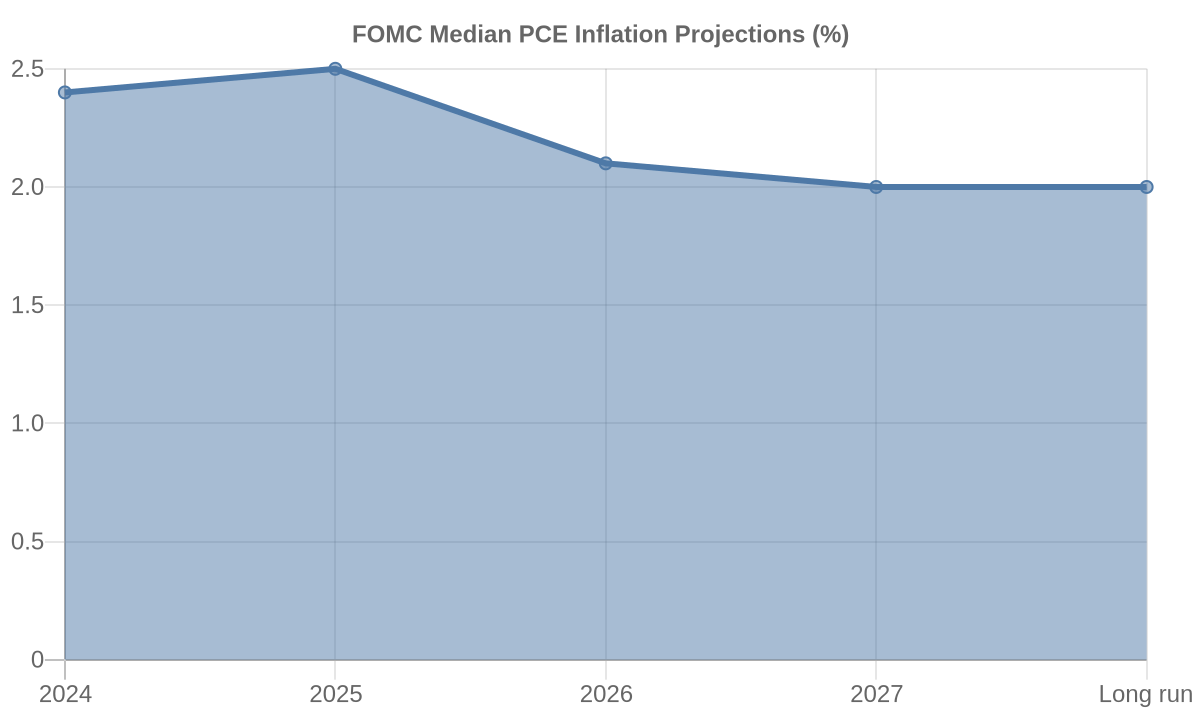
Federal Reserve median PCE inflation projections, FOMC Summary of Economic Projections
What is the Federal Reserve actually projecting? Its own longer-run goal, restated again in 2024, remains 2% inflation as measured by the personal consumption expenditures (PCE) index. The Fed's most recent projections put PCE inflation at 2.4% in 2024, 2.5% in 2025, easing to 2.1% in 2026, and settling at 2.0% by 2027 and beyond. The Congressional Budget Office tells a similar story, expecting inflation near 2.7% in 2024 and drifting down to about 2% by 2026. As you can see, the base case isn't runaway inflation. But it isn't a return to the unusually quiet 2010s either.
That matters, because the Fed's own history is instructive here. During much of the decade before the pandemic, inflation ran persistently below 2%, so much so that policymakers eventually committed to running inflation moderately above target for a while just to re-anchor expectations. That period is a useful historical reference point, not a template for what comes next. Longer-term survey measures, including the Survey of Professional Forecasters, still cluster around 2% for inflation five to ten years out, while consumers themselves report somewhat higher expectations (a median of 2.7% over three years and 2.9% over five, according to a widely cited 2024 survey). The gap between institutional anchors and household intuition is real, but it's a gap of a percentage point or so, not a gap between calm and crisis.
Of course, a central projection is not a guarantee. The Fed's own confidence intervals acknowledge this directly: its 70% range for inflation over the next few years spans roughly 0.4% to 3.6%, a wide enough band to include both a milder undershoot and a modestly hotter stretch. That width is the point. Professional forecasters aren't claiming to know the future. They're building frameworks wide enough to survive being wrong within limits, which is a fundamentally different exercise than predicting an outcome.
Growth assumptions follow the same modest, moderate pattern. The Fed's longer-run real GDP growth estimates cluster around 1.7% to 2.0%, and the CBO expects growth to settle near that same historical average as post-pandemic strength fades. Nobody in these projections is forecasting a boom. Nobody is forecasting a bust either.
So what does a moderate-but-uncertain world mean for a retirement portfolio? Capital-market assumptions compiled from major asset managers in early 2024 suggest nominal returns for U.S. large-cap stocks in the 5.2% to 7.0% range over 10 to 15 years, with international and emerging-market equities somewhat higher given their added risk. High-quality bonds, meanwhile, were projected around 4.6% to 5.8%. Translate those figures through an inflation assumption of 2% to 2.5%, and you get real returns of roughly 3% to 5% for stocks and 2% to 3% for bonds, the kind of arithmetic that underpins many long-term retirement models. This is precisely why diversified portfolios, not cash alone, remain central to those models: cash earns a return, but historically it hasn't kept pace with even moderate inflation over long stretches. (These figures represent forward-looking capital-market assumptions compiled from publicly available estimates by major asset managers as of early 2024 (see sources below). They are hypothetical projections, not guarantees of future performance. Actual returns will vary and may be significantly higher or lower. Past performance is not indicative of future results.)
The lesson here isn't that markets are safe or that inflation is solved. It's that the professionals building these frameworks aren't planning around either extreme story you hear at a dinner party. They're planning around a moderate center with real uncertainty on both sides, and building in room, through diversification, flexible spending, and cash buffers, for the range to move. History offers no promises about which part of that range shows up next. It does suggest that planning for the range, rather than for a headline, has served patient investors reasonably well.
Sources
- https://www.federalreserve.gov/monetarypolicy/fomcprojtabl20240612.htm
- https://www.federalreserve.gov/monetarypolicy/fomcprojtabl20240918.htm
- https://www.cbo.gov/publication/60419
- https://www.federalreserve.gov/monetarypolicy/files/20240705_mprfullreport.pdf
- https://www.clevelandfed.org/indicators-and-data/inflation-expectations
- https://www.bloomberg.com/news/articles/2024-03-11/americans-outlook-for-medium-longer-term-us-inflation-climbs
- https://www.philadelphiafed.org/surveys-and-data/real-time-data-research/inflation-forecasts
- https://www.federalreserve.gov/monetarypolicy/2025-02-mpr-part3.htm
- https://www.federalreserve.gov/publications/files/20240301_mprfullreport.pdf
- https://www.morningstar.com/portfolios/experts-forecast-stock-bond-returns-2024-edition
- https://www.federalreserve.gov/monetarypolicy/2024-03-mpr-summary.htm